Most AI Talk Is Opinion. This Is Practice.
Courses built from my own AI learning, in public.
LangChain & Agent Building
A linear, one-concept-per-lesson path through LangChain and agent building, from your first API call to a local research agent.
View course →
Corrective RAG
A linear, one-concept-per-lesson path through Corrective RAG (CRAG), grading retrieved chunks for relevance and correcting a bad retrieval before it ever reaches generation, built from scratch with no framework, from your first relevance grade to a complete FastAPI corrective RAG service backed by ChromaDB.
View course →
Multimodal RAG
A linear, one-concept-per-lesson path through Multimodal RAG, retrieval-augmented generation extended to cover images as well as text, built from scratch with no framework, from your first multimodal generate_content call to a complete FastAPI service that returns cited answers grounded in both text and images.
View course →
Graph RAG: Knowledge-Graph-Based Retrieval
A linear, one-concept-per-lesson path through Graph RAG, the knowledge-graph-based retrieval architecture, from extracting entities and relationships by hand to a complete FastAPI service combining networkx graph traversal with ChromaDB hybrid retrieval.
View course →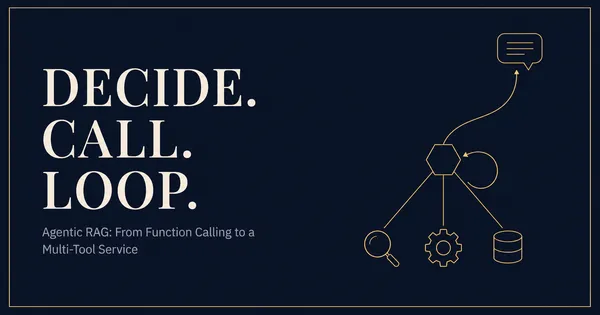
Agentic RAG: Retrieval as a Tool the Model Chooses
A linear, one-concept-per-lesson path through Agentic RAG, retrieval as a tool the model chooses to call rather than a fixed pipeline step, from Gemini's native function calling to a complete multi-tool FastAPI service built entirely from scratch.
View course →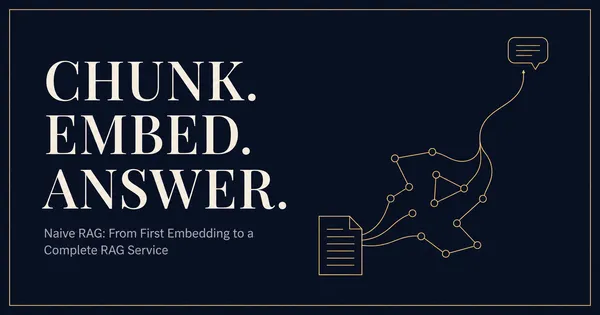
Naive RAG
A linear, one-concept-per-lesson path through Naive RAG, the baseline retrieval-augmented generation architecture, built from scratch with no framework, from your first embedding to a complete FastAPI RAG service backed by ChromaDB.
View course →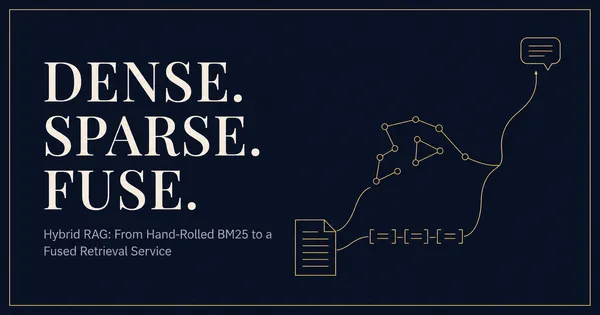
Hybrid RAG: Combining Dense and Sparse Retrieval
A linear, one-concept-per-lesson path through Hybrid RAG, dense (embedding) retrieval combined with sparse (keyword) retrieval, from hand-rolled BM25 to a complete FastAPI hybrid retrieval service.
View course →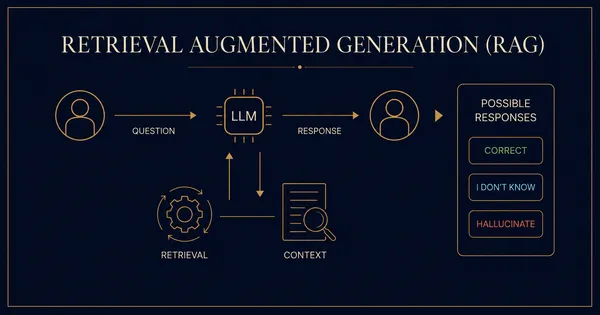
RAG Fundamentals: A Map of Every Architecture
A linear, one-concept-per-lesson survey of retrieval-augmented generation: the baseline pipeline, the nine named architectures built on top of it, and a decision framework for choosing among them.
View course →
Private Equity: From Investment Thesis to Exit
A linear, one-concept-per-lesson path through how private equity works, from evaluating a business to understanding value creation and investor returns.
View course →
Venture Capital: From First Check to Fund Returns
A linear, one-concept-per-lesson path through how venture capital works, from sourcing a deal and structuring a term sheet to fund economics and the power law that drives returns.
View course →
Angel Investing: From First Check to Portfolio
A linear, one-concept-per-lesson path through angel investing: sourcing deals, running diligence, negotiating SAFEs and term sheets, and constructing a portfolio of individual checks, without a fund behind you.
View course →
Langflow
A linear, one-concept-per-lesson path through Langflow, the visual low-code layer for building LLM flows, from your first drag-and-drop flow to graduating a prototype into production code.
View course →
LlamaIndex
A linear, one-concept-per-lesson path through LlamaIndex, from Document/Node/Index fundamentals to a multi-document agentic RAG capstone with structured, validated output.
View course →
LiteParse
A linear, one-concept-per-lesson path through LiteParse, a local, open-source, Rust-backed PDF parser, from your first parse call to a mixed native+scanned pipeline feeding LlamaIndex.
View course →
MarkItDown
A linear, one-concept-per-lesson path through MarkItDown, Microsoft's open-source library for converting a wide range of file formats into Markdown an LLM can read, from your first .convert() call to a Gemini-backed searchable index over a full mixed document folder.
View course →
Docling
A linear, one-concept-per-lesson path through docling, the IBM/LF AI open-source document-conversion library, from your first convert() call to a folder-to-queryable-chunks RAG ingestion pipeline.
View course →
Markdoc
A linear, one-concept-per-lesson path through Markdoc, Stripe's open-source Markdown-based authoring format, from your first parse-transform-render call to a folder-of-pages validate-and-publish pipeline.
View course →
Redis
A linear, one-concept-per-lesson path through Redis, the in-memory store agents lean on for fast, ephemeral state, from your first client connection to a multi-agent system using Redis for memory, queue, and cache.
View course →
Ollama
A linear, one-concept-per-lesson path through Ollama, running open-source LLMs on your own machine instead of a cloud API, from your first local generate call to a fully offline RAG agent.
View course →
Playwright
A linear, one-concept-per-lesson path through Playwright, from launching your first browser to an end-to-end web research agent.
View course →
pggraph
A linear, one-concept-per-lesson path through pggraph, the Postgres extension that compiles graph traversal and GQL/Cypher pattern matching on top of ordinary Postgres tables, from registering your first table as a node to a relationship-aware context API for AI agents.
View course →
MCP
A linear, one-concept-per-lesson path through the Model Context Protocol (MCP): building MCP servers first (tools, resources, prompts), then MCP clients, then wiring MCP tools into a real LangChain/Gemini agent.
View course →
pgvector
A linear, one-concept-per-lesson path through pgvector, the Postgres extension that turns an ordinary relational database into a place to store and search embeddings, from your first vector column to a production-shaped FastAPI RAG service.
View course →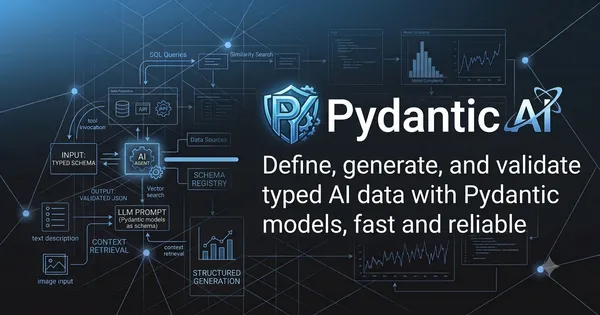
Pydantic AI
A linear, one-concept-per-lesson path through Pydantic AI: a type-safe agent framework from the Pydantic team, where an agent's output is a validated Pydantic model, not a string you hope is JSON.
View course →
LangGraph
A linear, one-concept-per-lesson path through LangGraph, the graph engine LangChain agents are built on, from your first graph to a multi-agent research assistant.
View course →
LangSmith
A linear, one-concept-per-lesson path through LangSmith: tracing, evaluating, and monitoring the agents built in the LangChain and LangGraph courses, in production.
View course →You've seen every course.
No courses match these filters yet.